 English
 Indonesia

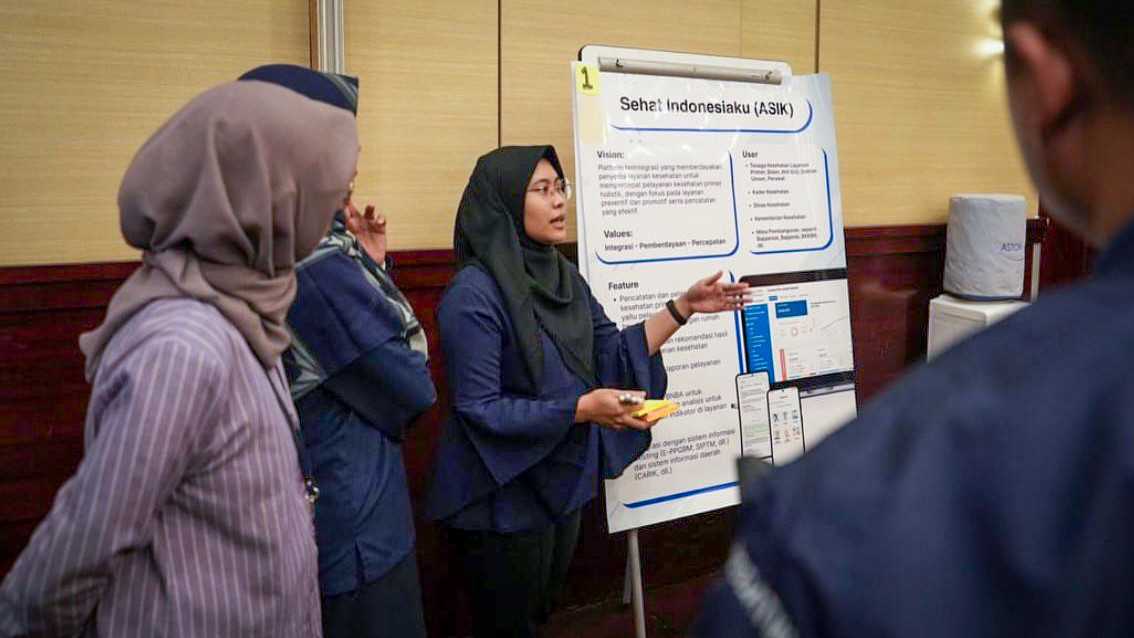
Imagine integrating healthcare services across more than 10,000 community health centers (puskesmas) throughout 17,380 islands in Indonesia. For many, this might seem impossible, but for Fauziah Mauly Rahman, this challenge underscores why digital health transformation matters. Through technology and system integration, healthcare services can reach more people while improving the quality of care.
As an Operation Analyst for the Primary Healthcare, Community, and Disease Control Working Team (Kesprimkom P2) under the Health Technology Transformation and Digitalization Team (TTDK) at the Ministry of Health of the Republic Indonesia (MoH Indonesia), Fauziah has been involved in numerous initiatives to develop and implement digital solutions for primary healthcare services.
Through these experiences, she has gained firsthand insights into the diverse conditions of primary healthcare services across different regions in Indonesia. She also learned that the success of digital transformation depends not only by the technology, but also by how well it addresses users’ needs and adapts to local conditions.
Understanding Challenges from the Field
One of the experiences that most shaped her perspective was when her team conducted an internet quality assessment at more than 10,000 puskesmas across Indonesia. The result showed that approximately one in five still had limited or had no internet connectivity. This finding highlighted that digital transformation is not only determined by the applications and systems development, but also on the readiness of the supporting infrastructure.
“I came to understand that infrastructure limitations, such as unstable internet access and limited electricity supply, can pose significant challenges to the utilization of technology. Therefore, any solution we develop must reflect real-world conditions,” said Fauziah.
In 2024, Fauziah and the Kesprimkom P2 Working Team participated in a cross-sector collaboration to pilot satellite-based internet connectivity in several puskesmas, particularly in Indonesia’s frontier, outermost, and disadvantaged regions (3T areas), as part of efforts to strengthen healthcare connectivity nationwide (read more: s.id/udcU2).
Beyond infrastructure challenges, she also observed how fragmented health information systems continue to hinder healthcare documentation and reporting processes. This situation demonstrates that digital transformation requires the availability of technology, but also integrated systems that effectively support healthcare workers’ workflows.
“One puskesmas may use between 30 and 40 different information systems. As a result, healthcare workers often have to manage dozens of separate platforms just to fulfill reporting requirements,” Fauziah explained.
According to her, the success of primary healthcare digital transformation requires more than technology alone. Strengthening infrastructure, integrating information systems, and enhancing human resource capacity must go hand in hand to enable healthcare workers to fully leverage technology in service delivery.
A Pause to Grow and Gain New Perspectives
After several years of involvement in various digital health initiatives, Fauziah decided to pursue a master’s degree in Australia in 2025. For her, this decision was not merely an academic pursuit, but an opportunity to deepen her understanding of how technology can support healthcare systems in a more sustainable way.
During her study, she explored various approaches to human-computer interaction (HCI), including methods for designing technology that is more user-centered. She also learned about digital health transformation roadmaps and best practices implemented in other countries.
“For me, education is an investment that allows us to view challenges through a broader lens. Returning back to college helped me to see problems from a much wider perspective,” Fauziah shared.
This experience further strengthened her belief that digital transformation cannot be achieved by a single stakeholder alone. It requires cross-sector collaboration, a willingness to learn continuously, and a commitment to making gradual improvements based on realities in the field.
“I learned that not every answer needs to be found from the very beginning. What matters most is maintaining curiosity, continuing to learn, and staying focused on the goals that we want to achieve.”
Returning Back to Contribute
Now, in 2026, Fauziah has returned to contribute to Indonesia’s health transformation efforts through the TTDK MoH Indonesia. She remains optimistic that by strengthening human resource capacity and utilizing appropriate technologies, primary healthcare services in Indonesia can continue to evolve and deliver greater benefits for both healthcare workers and the communities they serve.
Her journey demonstrates that digital transformation is a long-term process that requires sustained collaboration to ensure every innovation delivers meaningful impact. Ultimately, building a better healthcare system means building one that truly works for people.