 English
 Indonesia

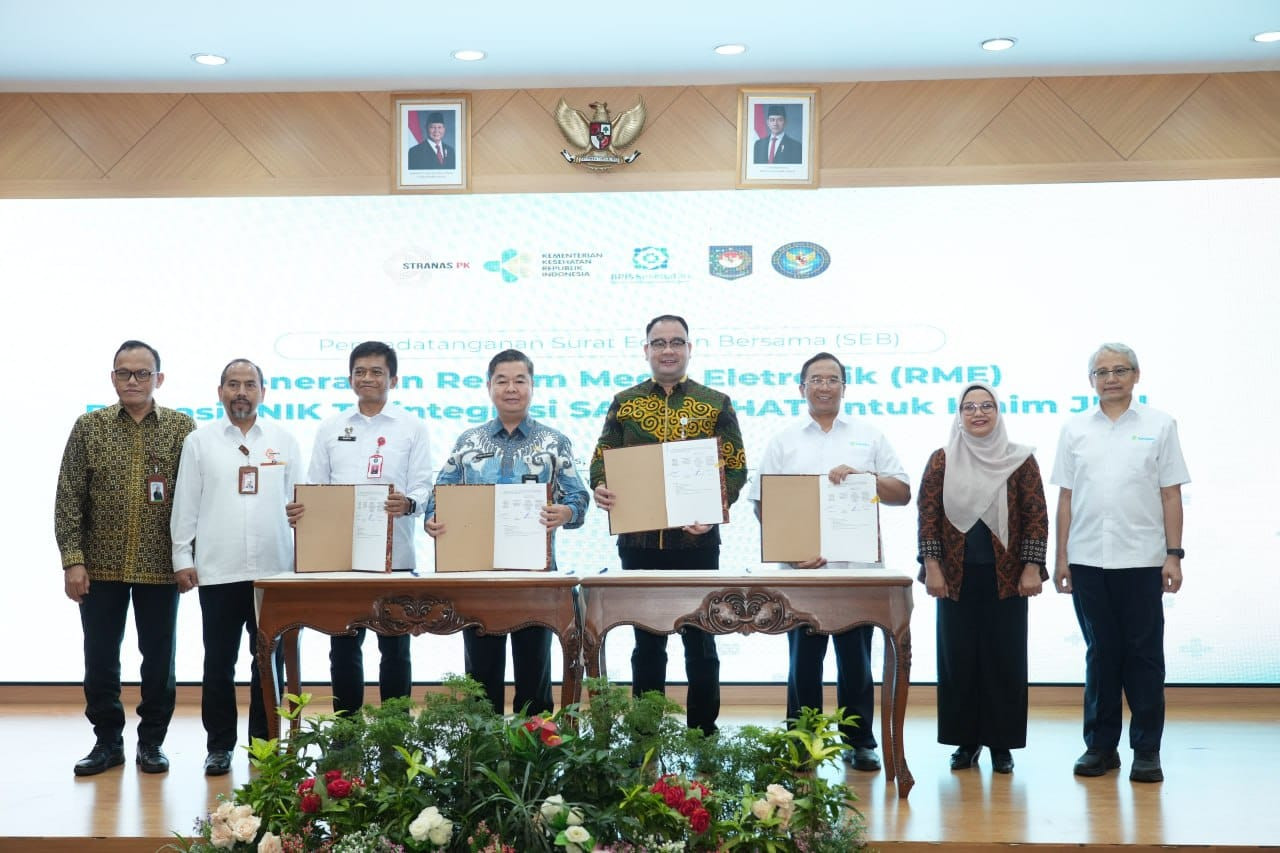
Jakarta, 30 July 2026 – Ministry of Health Republic Indonesia, together with the Corruption Eradication Commission (KPK), the Ministry of Home Affairs, Social Security Agency on Health (BPJS Kesehatan), and the National Cyber and Crypto Agency (BSSN), signed a Joint Circular Letter (SEB) on the Acceleration of Electronic Medical Record (EMR) Implementation integrated with the SATUSEHAT Platform for the management of National Health Insurance (JKN) claims on Thursday, 30 July 2026. This initiative marks an important milestone in strengthening healthcare governance that is more transparent, accountable, and based on digital data.
The Joint Circular Letter was signed directly by the Director General of Advanced Healthcare, dr. Azhar Jaya, SH., SKM, MARS, representing the leadership of the Ministry of Health in strengthening policy implementation within referral healthcare services. The Directorate General of Advanced Healthcare plays a strategic role in ensuring the optimal implementation of integrated EMR across all referral healthcare facilities, ranging from district and municipal hospitals to vertical hospitals and national referral hospitals.
In his remarks, Secretary General of the Ministry of Health Kunta Wibawa Dasa Nugraha emphasized that digital transformation is a key foundation for building a modern national health system. According to him, high-quality data will lead to high-quality services, more targeted policies, and greater public trust in healthcare services.
“In the digital era, data is no longer merely an administrative byproduct of healthcare services; it is a strategic national asset. Good data gives rise to good services, accurate data leads to appropriate policies, and strong data governance fosters public trust,” he stated.
He explained that the health transformation agenda, which is a strategic priority of the government as outlined in the President’s Asta Cita, the 2025–2029 National Medium-Term Development Plan (RPJMN), and Law Number 17 of 2023 on Health, is not only focused on infrastructure development and increasing the healthcare workforce, but also on building a national health data ecosystem that is integrated, interoperable, secure, and trustworthy.
The SATUSEHAT Platform, he continued, serves as the connector of the entire healthcare ecosystem in Indonesia. Through the integration of Electronic Medical Records based on the National Identification Number (NIK), patients’ health information can be accessed securely and continuously across different healthcare facilities.
The implementation of integrated EMR provides tangible benefits for the public. Patients no longer need to repeatedly carry physical documents or explain their medical history every time they move between healthcare facilities. At the same time, healthcare workers can focus more on providing care rather than completing administrative tasks, while the JKN claims process becomes faster and more efficient.
For the government and oversight authorities, this digital system creates traceable data trails that enhance transparency, strengthen supervision, and prevent potential irregularities in both healthcare services and health financing claims.
The Secretary General of the Ministry of Health stressed that the signing of this Joint Circular Letter is not merely the issuance of a regulation, but a concrete step toward building the foundation of a more modern and integrity-driven healthcare governance system in Indonesia. The SEB serves as a national guideline for hospitals in implementing NIK-based Electronic Medical Records integrated with SATUSEHAT as electronic supporting documents for JKN claims management.
According to him, the digitalization of healthcare services is also part of corruption prevention efforts through stronger governance. Valid data, transparent processes, documented systems, and traceable mechanisms are essential elements in building integrity in public services.
“We believe that prevention is always better than enforcement. Digitalization is not only about technology, but also about building integrity in healthcare governance,” he emphasized.
On the occasion, Kunta also expressed his appreciation to all ministries, agencies, regional governments, hospitals, and healthcare workers who have collaborated in supporting the implementation of digital transformation in the health sector.
He hopes that the signing of the Joint Circular Letter will become the starting point for stronger cross-sector synergy in delivering healthcare services that are faster, safer, more transparent, and trusted by the public.
“Public trust is not built by the number of regulations, but by our consistency in implementing good governance. Let us make this momentum the starting point for change toward a higher-quality and more integrity-driven healthcare system in Indonesia,” he concluded.
This press release is syndicated from the Directorate General of Advanced Health and rebroadcast by the Center for Data and Information Technology - Health Digitalization and Technology Transformation Team (Pusdatin-TTDK), Ministry of Health of the Republic of Indonesia. For further information, please contact Halo Kemenkes via hotline 1500-567, WhatsApp chatbot 0811-10-500-567, or email [email protected].