 English
 Indonesia

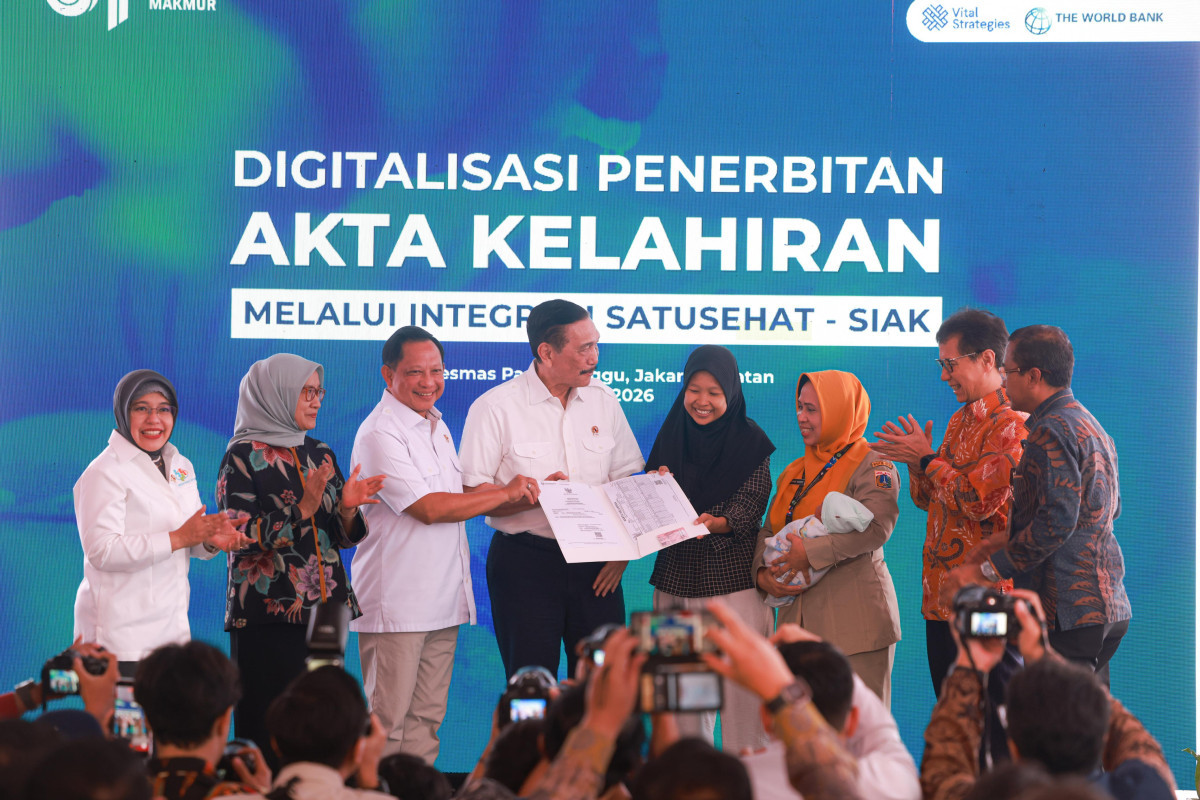
Jakarta, 11 August 2026 – The Ministry of Health and the Ministry of Home Affairs have strengthened digital service integration through the integration of SATUSEHAT and the Population Administration Information System (SIAK) to simplify the issuance of birth certificates. The service was launched at Pasar Minggu Community Health Center (Puskesmas), South Jakarta, on Tuesday (11/8/2026).
Through this integration, birth data recorded by health workers at healthcare facilities can be transmitted digitally through SATUSEHAT to SIAK. After the verification process, population administration documents can be delivered digitally to parents or guardians.
Chair of the National Economic Council and Chair of the Committee for the Acceleration of Government Digital Transformation, Luhut Binsar Pandjaitan, stated that data integration across ministries and institutions is a crucial foundation for building a government that is more efficient, effective, and well-targeted.
“Dukcapil is the backbone. Once we are connected to Dukcapil and ministries and agencies can communicate through their data, the process will become much faster,” said Luhut.
According to Luhut, data integration is also important to remove barriers between ministries and institutions, allowing data to be exchanged more quickly while maintaining each institution’s authority as the data steward.
In line with this, Minister of Health Budi Gunadi Sadikin said that data integration must be translated into services that provide direct benefits to the public, including the integration of birth data from healthcare facilities with the population administration system.
“We want the data to be valid and integrated so that there are no longer conflicting records. Babies born at community health centers or hospitals will be able to receive three documents at once: a birth certificate, a Family Card, and a Child Identity Card,” said the Minister.
Under this mechanism, parents or guardians no longer need to process documents separately. After verification by the Directorate General of Population and Civil Registration (Dukcapil), the documents can be sent through SIAK Online email and will be equipped with a QR Code. For parents or guardians who do not have an email address, the documents can be obtained through the healthcare facility.
Minister of Home Affairs Tito Karnavian said that the integration of digital services will make the issuance of population documents faster and more efficient.
“The public no longer needs to struggle with complicated bureaucracy. All systems will be connected and integrated automatically, so services can be delivered quickly, accurately, and transparently,” said Tito.
Head of Statistics Indonesia (BPS) Amalia Adininggar Widyasanti also expressed support for the digitalization of birth certificates as an effort to accelerate the registration of children’s identities while strengthening Indonesia’s vital statistics. Based on the March 2026 National Socioeconomic Survey (Susenas), birth certificate ownership among children aged 0–17 years had reached 94.6%, but around 5.4% of children still did not have a birth certificate. Coverage in several areas of Papua and East Nusa Tenggara remains below 90%.
“This digitalization of birth certificates will continue to improve the accuracy of child registration so that children can obtain their rights because they are properly recorded in our population and statistical systems,” said Amalia.
President Director of BPJS Kesehatan, dr. Prihati Pujowakito, said that the integration of birth certificates with National Health Insurance (JKN) membership data can also accelerate participant data updates while reducing the potential for duplicate records.
“With birth certificates connected to BPJS Kesehatan, parents of newborns will no longer need to complete the process manually. The data can be sent directly and processed online,” she said.
The digital birth certificate service through SATUSEHAT–SIAK integration began with a pilot at Harapan Kita Mother and Child Hospital (RSAB Harapan Kita) on 31 July 2026 and is now available at community health centers. The integration will be expanded gradually to all healthcare facilities that provide maternity services.
Collaboration between the Ministry of Health and the Ministry of Home Affairs has been underway since January 2026. Going forward, the integration will also cover death registration and cause-of-death recording.
Through this innovation, the government is promoting public services that are easier, faster, and more integrated, so that people no longer need to move from one office or service to another to fulfill administrative requirements after childbirth. At the same time, the government will obtain birth data that is more accurate, up-to-date, and timely to support policy planning and public service delivery.
This press release is syndicated from the Bureau of Communication and Public Information under the title “Integrasi SATUSEHAT-SIAK, Bayi Lahir Bisa Dapat Akta Kelahiran, KK, dan KIA Sekaligus” and republished by the Center for Data and Information Technology - Health Technology Transformation and Digitalization Team (Pusdatin-TTDK), Ministry of Health of the Republic of Indonesia.
For further information, please contact Halo Kemenkes through hotline 1500-567, WhatsApp chatbot +62 811-10-500-567, or email [email protected].